Learning a language requires much more than simply grasping its vocabulary and grammar rules. To truly “speak” the language and connect with native speakers, you must master *idioms*—which go beyond the dictionary meanings of words and function like cultural codes. Turkish is one of the world’s richest languages in this regard. When expressing their emotions, surprise, or anger, Turkish people typically turn to idioms—refined over centuries—rather than constructing a direct sentence.
Idioms are like the “spices” of a language. They add flavor, depth, and character to the core words that form the dish. For a foreigner, hearing the phrase “Her skirt is jingling” might seem confusing at first; but once you grasp the joy behind this metaphor, you begin to understand not just the language, but the Turkish spirit as well.

In this article, we’ll explore the seven most interesting idioms you’ll frequently encounter in daily life—and their stories—to help you grasp the logic of the Turkish language.
1.Etekleri Zil Çalmak
This idiom expresses the *overwhelming joy and excitement* a person feels in response to an event. Although a literal translation might conjure up the absurd image of bells ringing on the hem of someone’s clothing, the meaning it conveys is entirely positive energy.
* *When Is It Used?* It is used when receiving long-awaited news, when it becomes clear that one will reunite with a loved one, or when a major success is achieved.
2.Burnundan Kıl Aldırmamak
Pride and honor are important concepts in Turkish culture. This idiom is used to describe people who are *extremely arrogant, self-centered, and unable to tolerate even the slightest criticism*. These individuals feel so “untouchable” that they are stubborn enough not to even bother plucking a hair from their nose (a minor flaw).
* *When Is It Used?* It is used to describe difficult people who refuse to apologize even when they are wrong or who always claim to know best.
3.İncir Çekirdeğini Doldurmamak
This is one of the most elegant idioms in Turkish used to describe “busying oneself with trivial matters” or “insignificant issues.” As you know, a fig seed is one of the smallest things in the world. If a debate or topic can’t even fill the inside of that seed, then the matter is *utterly trivial and worthless.*
* *When Is It Used?* It’s perfect for describing arguments that arise over trivial reasons or time wasted on nonsense.
4.Göz Boyamak
This is an idiom you’ll encounter everywhere, from the world of marketing to everyday relationships. It means *presenting something as if it were excellent by hiding its flaws, deceiving, or misleading*, rather than showing it as it truly is. It’s a form of creating an illusion.
* *When to Use It?* It’s used for those who try to hide a product’s poor quality with flashy packaging or put on a fake show of kindness to cover up a mistake.

5.Küplere Binmek
There are many ways to describe anger in Turkish, but “climbing onto the cubes” is the most vivid. It expresses that a person is *extremely angry and has lost control due to rage*. It’s a metaphor inspired by the sight of someone jumping with anger in the old days, as if they were climbing onto large cubes and stomping on them.
* *When Is It Used?* It describes the extreme reaction you have when you see someone make a huge mistake or when your patience has finally snapped.
6.Ayıkla Pirincin Taşını
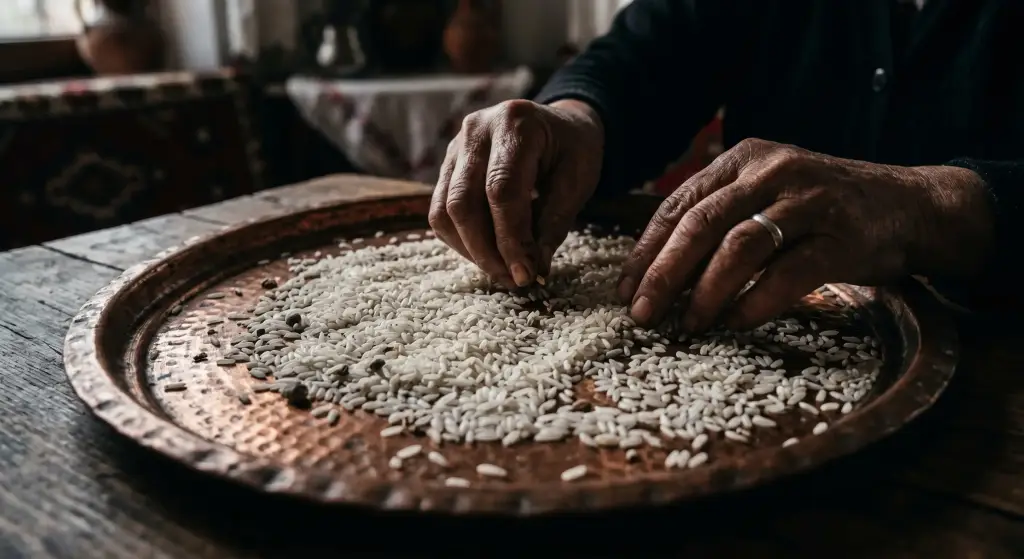
Here’s a true “dead end” idiom. It’s used when a task becomes impossible to resolve, *when one is faced with a complex and intractable problem*. In the past, it was difficult to find the white stones that got mixed in while sorting rice; if the rice was full of stones, the job seemed never-ending.
* *When Is It Used?* It’s typically used as an expression of frustration when a mistake has been made and correcting it has become a very difficult process.
7.Havadan Sudan Konuşmak
In Turkish hospitality, staying silent isn’t well-received. However, talking about serious topics all the time can be exhausting. This idiom means *chatting about trivial, everyday, ordinary, and general topics*. It’s a form of “small talk.”
* *When Is It Used?* It’s used to describe superficial conversations made to pass the time when meeting an old friend or waiting at a bus stop.
Why Are Idioms So Important?
Idioms prove that Turkish is not just a means of communication, but also a *form of art*. These set phrases carry traces of society’s past way of life, culinary culture, and social observations. For example, “fig seed” reflects an agricultural observation, while “climbing into barrels” brings old household items into the language.
As a student of a foreign language, when you use these idioms, you’re not just constructing correct sentences; you’re also demonstrating *sensitivity and respect* for Turkish culture. Instead of telling a Turkish friend that you’re very happy, if you say, “My skirt is ringing with joy right now!” you’ll see the ice between you melt instantly and a genuine smile appear on their face.
A Little Tip:
Idioms are *fixed* expressions. This means you can’t change the words within them. For example, if you say “My pants are ringing” instead of “My skirt is ringing,” the meaning is completely lost. That’s why the best approach is to memorize them as a whole, like a “word block.”