Travelling to a foreign country is not just a geographical change; it is also stepping into a new social universe full of unwritten rules. In Turkey, you may attend a language course, learn the grammar rules to perfection, or read street signs with ease. However, when you are invited into the heart of Turkish culture—that is, into a Turk’s home—you will encounter a completely different world that isn’t found in textbooks.
For Turks, ‘home’ is not merely a shelter consisting of four walls. It is a sacred sanctuary of privacy, cleanliness and, most importantly, hospitality. The moment you step through the door of a Turkish home, you find yourself amidst centuries-old traditions, loving insistence and unspoken rules regarding cleanliness that are strictly observed.
If you’ve recently been invited to a Turkish friend’s home and want to avoid committing a cultural faux pas, this detailed guide is just what you need. Here are all the unspoken rules you need to know, from the doorstep to the kitchen table!
1. The First Big Test: The Doorstep and the Shoe Paradox
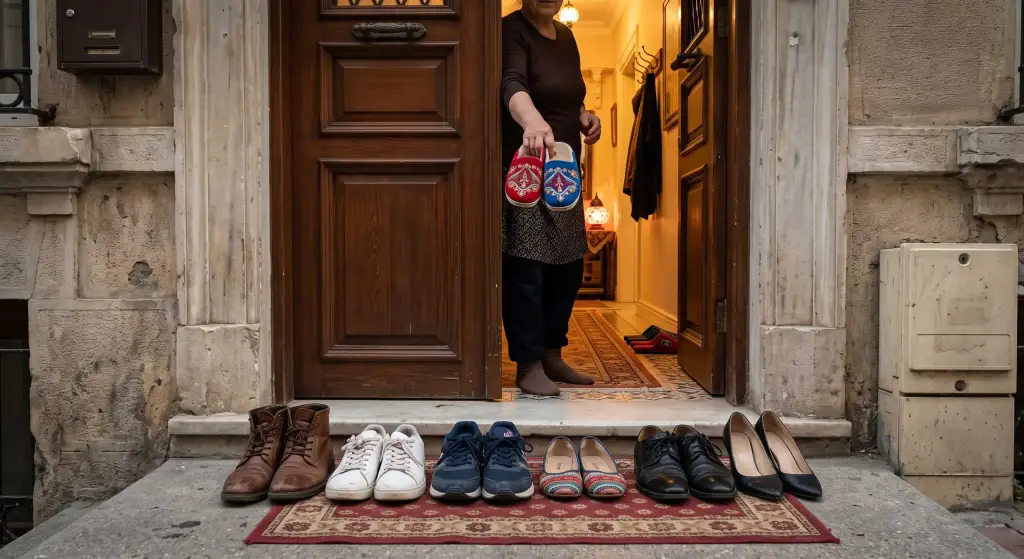
The first and strictest rule you need to know when approaching a Turkish home is this: shoes are never, ever allowed inside.
Unlike in Western culture, entering a home with your shoes on in Turkey is not just a matter of cleanliness; it is also a major sign of disrespect towards the host and their living space. Turks want to leave the dirt, dust and negative energy of the streets outside.
So what awaits you at the door?
When the flat door opens, you’ll see shoes of all sizes lined up outside. This is the first sign that you’re in the right place. The first thing you should do as soon as the door opens is to take off your shoes on the doormat outside the door, facing the host.
Golden Rule: When taking off your shoes, make sure your socks are clean and free of holes! This is one of the minor cultural shocks that foreign students most commonly experience – and later look back on with a laugh.
2. The Slipper Selection Ritual: ‘Which Slippers Shall I Give You?’
The moment you take off your shoes, your host will probably ask you this magical question: ‘Which slippers shall I give you?’ or simply place a pair of slippers right in front of you.
In Turkish homes, there are clean, ‘guest slippers’ – usually made of plush or plastic – kept especially for visitors. Even if you know the floors are clean, it is polite to wear the slippers offered by your host. This is because, according to Turkish belief, no matter how clean the floors may be, stepping on them barefoot leads to ‘cold feet’ and, inevitably, falling ill. Your host wants to protect you, so let them.
The Slipper Hierarchy
A small detail: when you go to the bathroom or toilet, you must take off your house slippers and put on the ‘wet area slippers’ designated for that space. Entering the bathroom in your house slippers or returning to the living room in your bathroom slippers is a cause for an unspoken crisis in a Turkish home.
3. Welcome Ceremony and Cologne Offering
You’ve entered the house and put on your slippers. Now it’s time for a mutual display of affection. The host will greet you with “Welcome!”. The standard and most heartfelt reply you should give is: “Thank you for having us!”
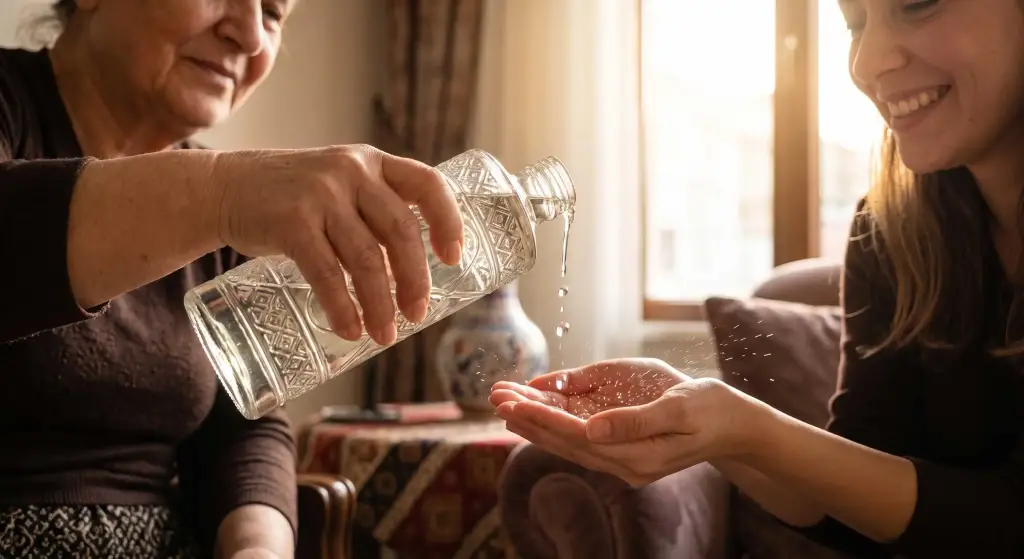
Immediately afterwards, as you settle into a chair in the living room, the host will appear holding an elegant bottle: cologne. This traditional liquid, usually scented with lemon, serves both as a refresher and a kind of disinfectant.
- When the host pours a few drops of cologne into your palm, you can rub your hands together and gently dab it onto your face and neck.
- This ritual is a cultural way of saying, ‘You have brought pure and clean energy into our home; we welcome you with freshness.’
4. The Hunger Test: ‘You’re Not Hungry, Are You? But I’ve Prepared Something Anyway’
The mathematical probability of going hungry in a Turkish home is zero. Even if you’ve arrived feeling full, it’s almost certain you’ll leave with a few extra calories.
In Turkish hospitality, feeding the guest is a matter of honour. Once you sit down at the table, you’ll see that the plates are constantly being refilled. The most important concept to understand here is the ‘Culture of Insistence’.
- Declining the first offer: If you really don’t want a particular dish or are already very full, simply saying “No, thank you, I’m really full” when first offered won’t make any difference. The host will interpret this as you being “too polite to say no” and will still put that pastry on your plate.
- To really put a stop to it: You need to set a clear boundary by placing your hand lightly on your plate, making eye contact and saying, ‘Thank you very much, and well done on the cooking, but I really can’t eat any more – it was delicious.’
- Finishing your plate: Leaving food on your plate may be interpreted as not enjoying the meal. Therefore, the safest approach is to ask for as much as you can eat and then finish it.
5. The Endless Gathering: Tea and Coffee Rituals
If you think the evening is over once the meal has finished, you’re mistaken. The real social interaction is only just beginning.
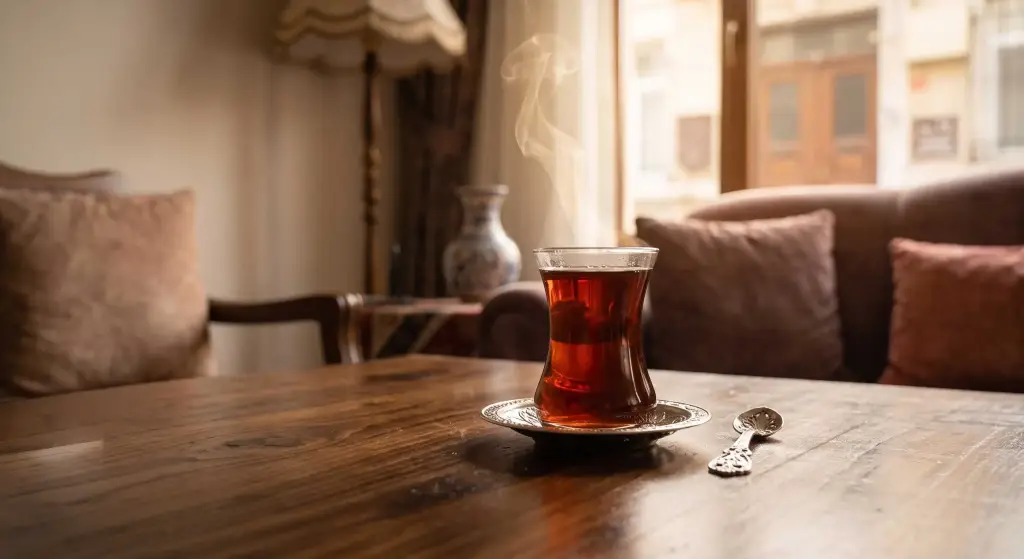
First, Turkish tea is brewed in those famous slender-waisted glasses. Tea is the fuel for conversation in Turkish homes. Every time your glass empties, the host will refill your tea without being asked. If you no longer wish to drink tea, you should place your tea spoon horizontally across the rim of the glass. This is a universal Turkish sign language gesture meaning ‘Thank you, that’s enough’.
After the tea (or sometimes before), Turkish coffee is served. When the coffee is served, you’ll always be asked, ‘How would you like it?’ Here are the coffee order codes:
- Sade: Without sugar
- Az şekerli: Half a teaspoon of sugar
- Orta: One teaspoon of sugar
- Şekerli: Two teaspoons of sugar
After drinking your coffee, turning the cup upside down on the saucer and placing a ring or a coin on top to let it cool is an invitation to a fortune-telling ritual. If there’s someone at home who knows how to read fortunes, your evening will be much more entertaining.
6. Parting Is Also Part of Love: When It’s Time to Leave
Leaving a Turkish home is a process with its own set of rules. You cannot suddenly stand up as midnight approaches and say, ‘I’m off’.
First, the situation is assessed: ‘Shall we get up gradually now?’
The host will, as a matter of course, object: ‘Oh, it’s still early, let’s stay a bit longer!’ or ‘You should stay the night.’
This dialogue is a polite dance that shows the parties care for one another and haven’t realised how time has flown. You can politely thank them for these sweet insistence and proceed with your departure. When you reach the door, don’t forget to say ‘Ellerinize sağlık’ to the host for everything you’ve eaten, and ‘Thank you for everything’ for their hospitality.
Final Thoughts: The Great Love Behind the Unwritten Rules
From the outside, shoes, slippers, endless insistence on eating, and cologne might seem like a complex set of rules. However, behind all these unwritten rules lies a single fundamental motivation: to make you feel at home and to show that you are valued.
In Turkish culture, a guest is regarded as a ‘guest of God’ and is believed to bring good fortune to the home. So even if you don’t follow the rules to the letter, you can be sure that your host will treat you with nothing but kindness and a warm smile. Now, put on your spotless socks, accept that invitation and enjoy this unique experience!