For centuries, Turkey has been a region where different cultures, civilisations and belief systems have intersected. Consequently, Turkish culture encompasses not only official religious beliefs but also numerous traditional beliefs passed down from generation to generation amongst the people. A significant portion of these are referred to as ‘superstitions’. Superstitions are beliefs and practices that lack a scientific basis yet continue to thrive within society.
Whilst some people view these beliefs purely as a form of entertainment, others still pay attention to these traditions in their daily lives. Particularly in Anatolia, superstitions continue to exert their influence across many aspects of life, from birth to death, and from marriage to the evil eye.
When it comes to superstitions in Turkey, one of the first topics that springs to mind is undoubtedly the evil eye and the evil eye bead. Known as a small blue bead, the evil eye bead is not merely an ornament; it is also one of the most powerful symbols of Turkish culture.
What Is a Superstition?
A superstition is a traditional belief that generally has no logical or scientific explanation, yet which people believe to be true. These beliefs often arise from fears, hopes, a desire for protection, or curiosity about the unknown.
Throughout human history, people have developed various symbols and rituals to ward off misfortune, bring good luck, or protect themselves from unseen forces. This is also quite common in Turkish society.
For example, some people believe that cutting one’s nails at night brings bad luck. Others believe that walking under a staircase brings bad luck. Most of these beliefs are cultural customs from the past that have been carried over to the present day.
What is the Belief in the Evil Eye?
The belief in the evil eye is one of the most widespread superstitions in Turkey. The evil eye is thought to occur when a person directs negative energy towards another person, an animal or an object through jealousy, admiration or an intense gaze.
The phrase “to be struck by the evil eye” is frequently used in everyday speech. It is particularly believed that very beautiful, successful, healthy or striking individuals may fall victim to the evil eye. A baby suddenly crying, a newly purchased item breaking, or things going wrong are sometimes attributed to the evil eye.

In Turkey, people rarely fail to say “Maşallah” when they really like something. This is because it is thought that simply offering praise could invite the evil eye. Consequently, the word “Maşallah” is believed to have a protective effect.
The Tradition of the Evil Eye Bead
When it comes to superstitions in Turkey, one of the most powerful symbols that springs to mind is the Evil Eye Bead. This eye-shaped bead, featuring blue, white and black colours, is a traditional object believed to protect against the evil eye.
The History of the Evil Eye Bead
The history of the Evil Eye Bead goes back a very long way. Historians note that protective symbols in the shape of an eye date back to the civilisations of Mesopotamia, Ancient Egypt and Anatolia. For thousands of years, people have believed that the eye symbol reflects negative energy back.
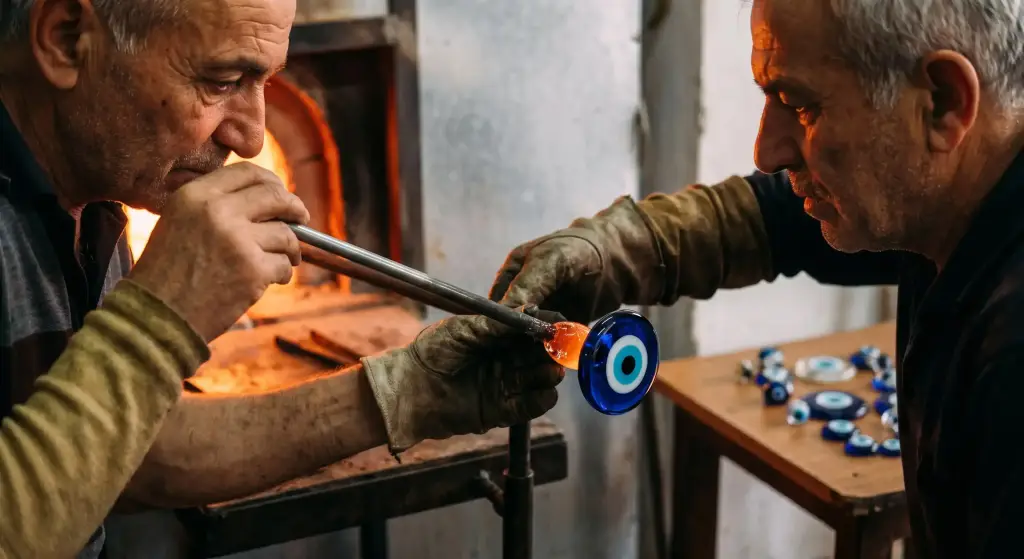
In Turkish culture, the evil eye bead has become particularly widespread in Anatolia. Handmade evil eye beads crafted by glass artisans have, over time, come to hold both cultural and commercial value.
In particular, in some villages around Izmir, evil eye beads are produced using traditional methods. These beads are made by shaping glass at high temperatures. It is believed that the dark blue colour used in traditional production possesses protective powers.
Why Is the Evil Eye Bead Blue?
Throughout history, the colour blue has been regarded as protective because it represents the sky and water. Furthermore, in ancient societies, as people with blue eyes were rare, it was believed that eye contact carried powerful energy. For this reason, beads shaped like blue eyes were made to neutralise negative energy.
Today in Turkey, the blue evil eye bead is not merely a traditional object but also one of the country’s cultural symbols. It is commonly seen in tourist shops, homes, cars and jewellery.
Where Is the Evil Eye Bead Used?
In Turkey, people use the evil eye bead in many areas of life to protect themselves from the evil eye.
In Homes
Many homes have an evil eye bead at the entrance. It is believed that this prevents negative energy from entering the home. Hanging an evil eye bead is particularly common in newly moved-into homes.
For Babies
It is believed that newborn babies are vulnerable to the evil eye. For this reason, small evil eye beads are attached to babies’ clothes. It is also common to see evil eye beads on prams or in their rooms.
In Cars
In Turkey, many drivers hang evil eye beads in their cars. It is believed that this protects against accidents and negative energy.
In Jewellery
The evil eye motif is very common in necklaces, bracelets, earrings and rings. Today, this motif has also gained a significant place in the fashion world.
In Workplaces
It is a traditional custom to hang an evil eye charm in newly opened shops. People choose to do this to prevent business from going badly and to bring prosperity.
The Breaking of the Evil Eye Bead
According to a widespread belief in Turkey, if an evil eye bead breaks, it means it has absorbed negative energy. For this reason, many people throw the broken bead away and replace it with a new one.
Whilst some people view this as a mere coincidence, this belief is quite strong amongst the general public.
Other Superstitions in Anatolia
There are numerous interesting superstitions across different regions of Turkey.
Cutting Nails at Night
In Anatolia, it is believed that cutting nails at night brings bad luck. In the past, when there was no electricity, the danger of cutting nails at night may have led to the emergence of this belief.
Walking Under a Staircase
It is thought that walking under a staircase brings bad luck. This belief exists not only in Turkey but in many parts of the world.
Ringing in the Ears
When a person’s ears ring, it is said that ‘someone is talking about you’. A ringing in the right ear is thought to portend good things, whilst a ringing in the left ear is interpreted as bad talk.
Knocking on Wood
After mentioning something bad, people sometimes knock on wood three times. It is believed that this wards off bad luck.
Black Cats
Some people believe that black cats bring bad luck. However, this belief is not universally accepted and its influence has diminished, particularly in modern urban life.
Leaving Scissors Open
It is believed that leaving scissors open in the home brings arguments and discord. For this reason, elders insist that scissors be kept closed.
The Psychological Aspect of Superstitions
One of the key reasons for the emergence of superstitions is people’s desire to feel safe in the face of the unknown. People create symbols and rituals to make sense of events they cannot control.
For example, wearing an evil eye bead can give a person a psychological sense of protection. For this reason, superstitions can be seen not only as traditions but also as a means of emotional comfort.
Superstitions in Modern Turkey
Despite technological advancements, superstitions have not completely disappeared in Turkey. Even in the age of social media, people use evil eye charm emojis, write ‘Maşallah’ and continue to observe certain traditions.
Even among younger generations today, the evil eye charm remains quite popular. This symbol, combined with modern designs, continues to exist as both a traditional and aesthetic element.
For tourists, the evil eye charm is also one of Turkey’s most striking cultural artefacts. Many foreign tourists visiting Turkey purchase an evil eye charm as a souvenir.
Superstitions and Cultural Identity
Although superstitions are not accepted as scientific facts, they form an important part of our cultural heritage. These beliefs reflect the history, fears, hopes and way of life of societies.
In Turkey, the evil eye bead is not merely an ornament; it is a symbol of people’s quest for protection, security and positive energy. This culture, stemming from the ancient traditions of Anatolia, remains an integral part of daily life today.
Superstitions in Turkey are strong cultural customs passed down from the past to the present. Beliefs such as the evil eye, the evil eye bead, knocking on wood, and not cutting one’s nails at night continue to live on in the collective memory of society.
In particular, the evil eye bead has become one of Turkey’s most important cultural symbols. Used in every aspect of life, from homes to cars, from babies to jewellery, this small blue bead represents people’s desire to protect themselves from negative energy.
Although not scientifically proven, superstitions tell the cultural story of societies. This is because people do not live by logic alone; they also live through traditions, symbols and emotions.